TPM · CollMind TPM
CollMind productTrade Promotion Management: from plan to return
CollMind TPM manages the trade support an FMCG manufacturer gives retailers and distributors in one data model: it plans promotions at product-group level, commits them from a budget envelope, routes them through approval with reasons and turns them into agreements, calculating the return with the same formula everywhere.
A large line on the P&L, with little visibility
Discounts, shelf and catalogue support and volume rebates are among an FMCG company’s largest costs, yet they are often managed in disconnected spreadsheets. Approved plans do not reduce the budget, the return is calculated with a different formula in every file, and approvals stay in email threads. CollMind TPM brings planning, budget, approval and agreements into one flow.
Modules
Explore CollMind TPM module by module
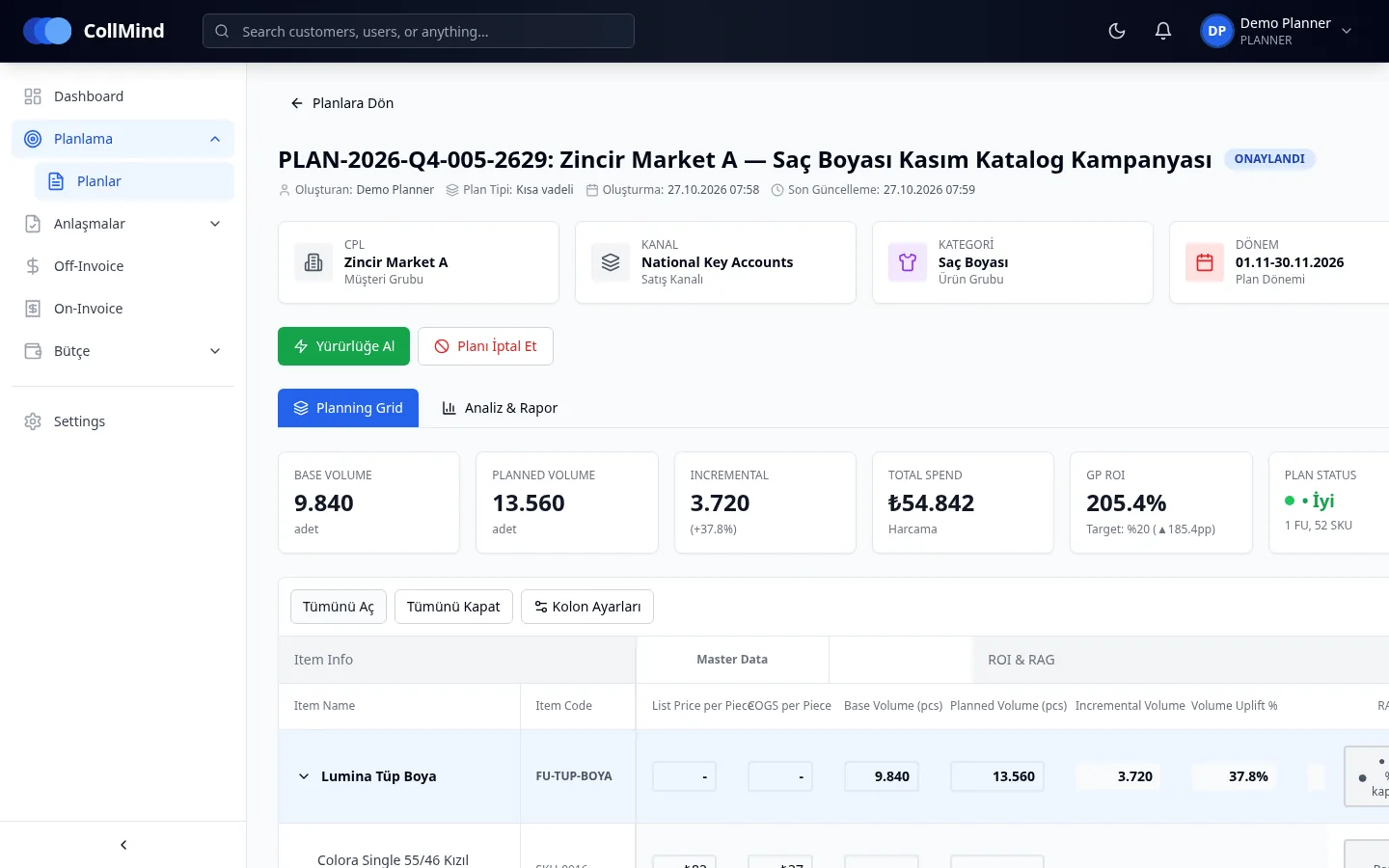
Planning
Tactic and volume entry at product-group level; distribution to SKUs by historical share, instant spend and profitability.
Explore →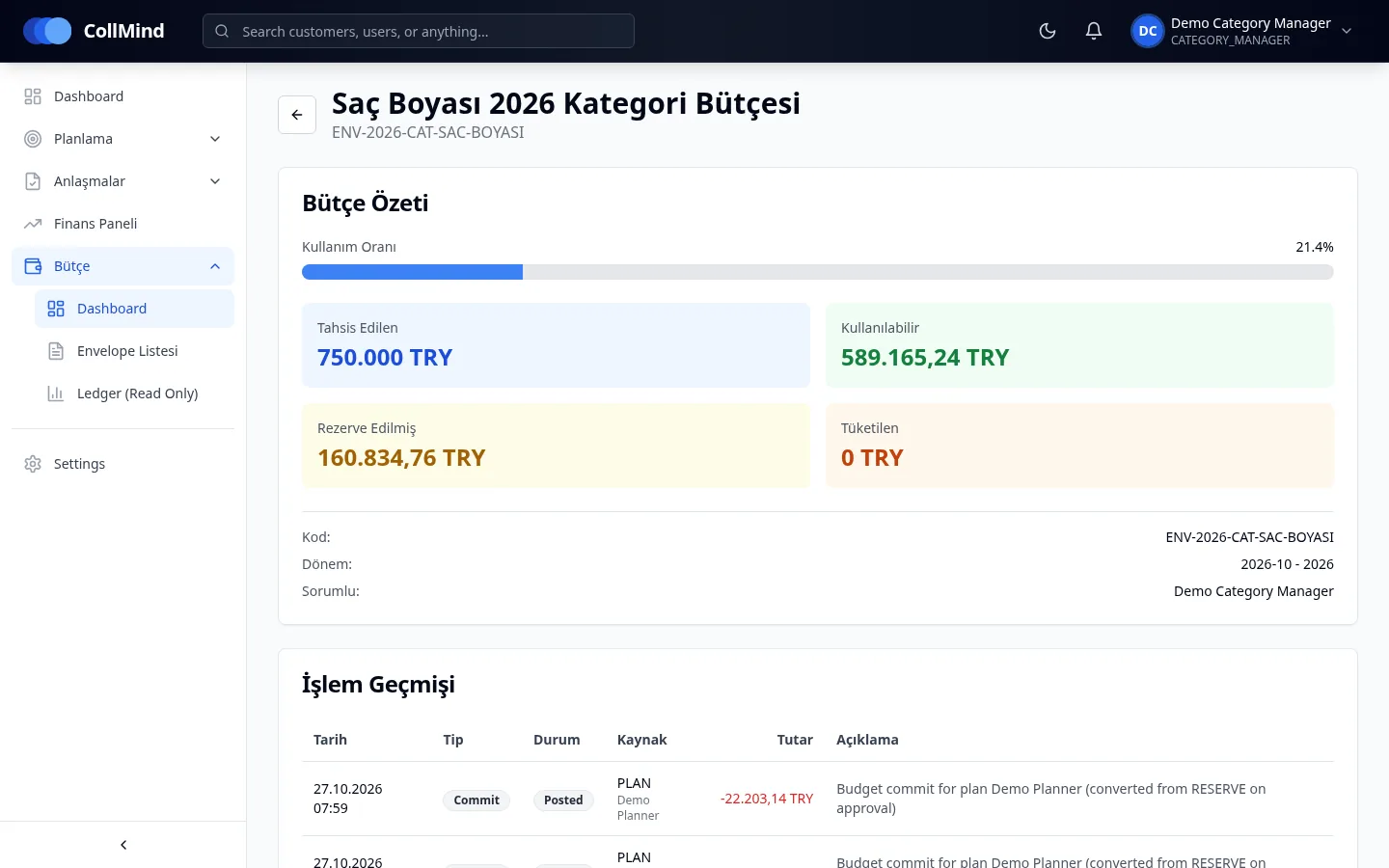
Budget and fund control
Category (and channel) × period envelopes; approved plans are committed and every movement goes to an immutable ledger.
Explore →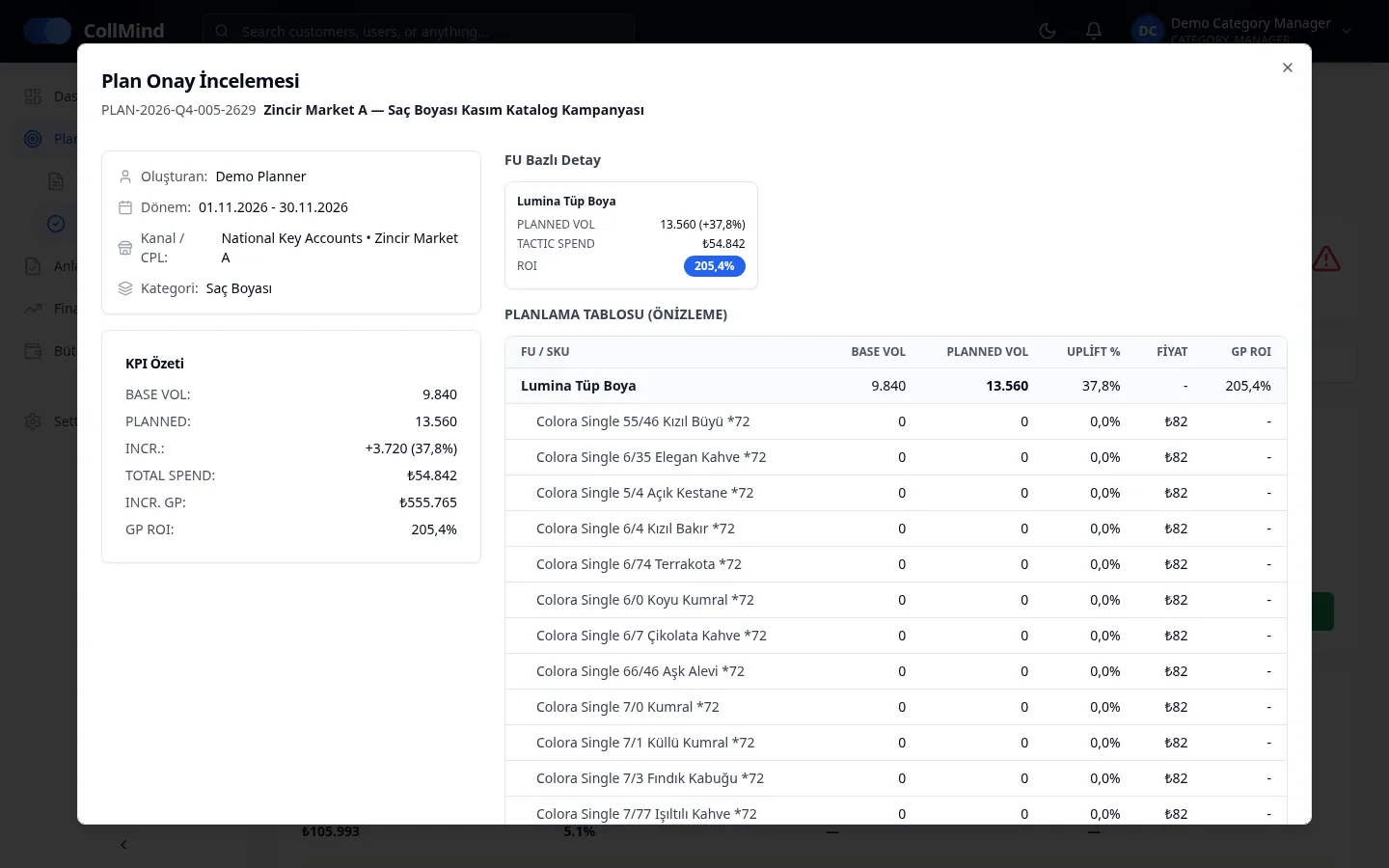
Approval workflow and permissions
An approval queue with KPIs, decisions with reasons, segregation of duties; role- and scope-based access.
Explore →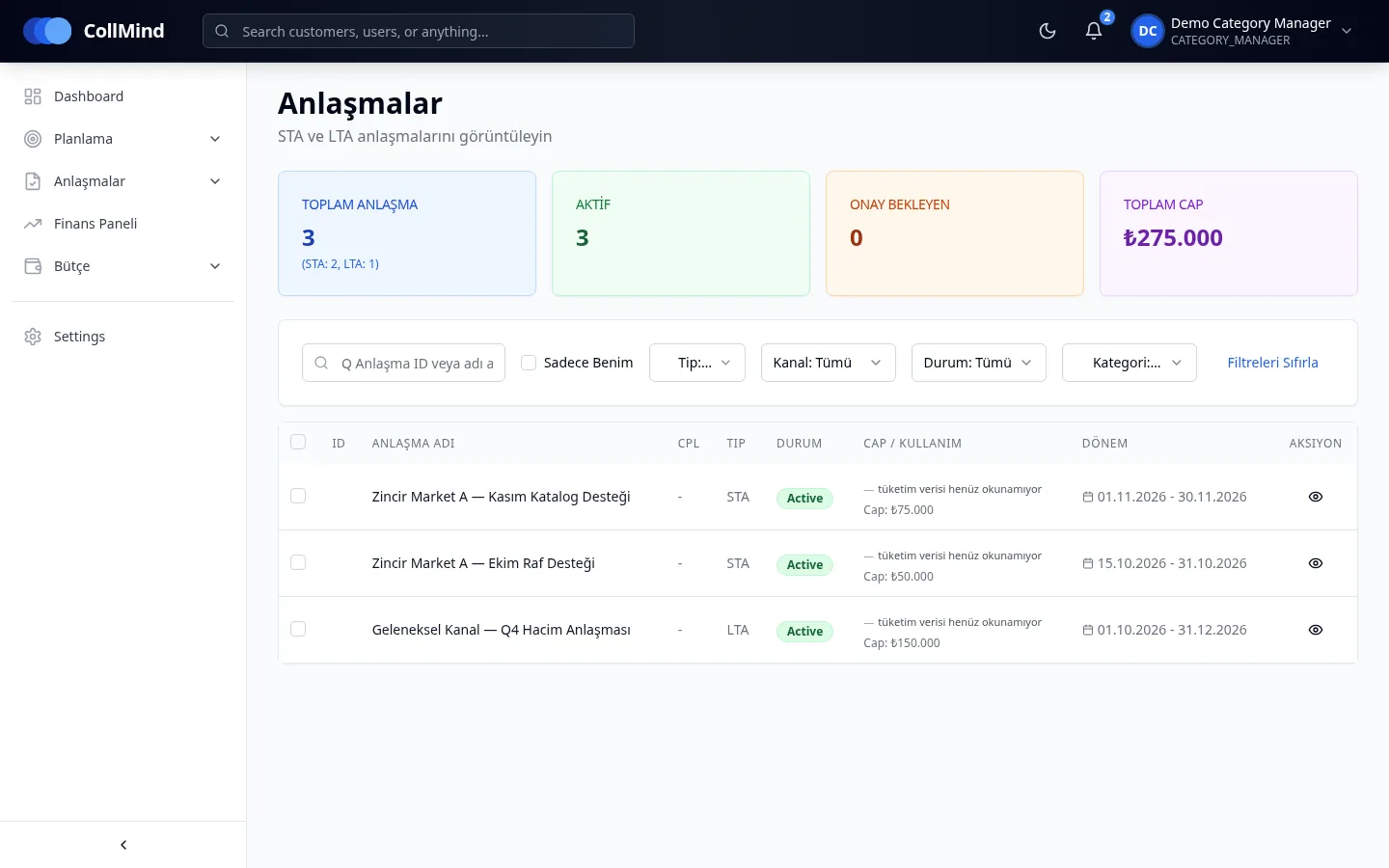
Agreements and claims
Short- and long-term agreements; on/off-invoice uploads, row-level validation, manual claims and reversing entries.
Explore →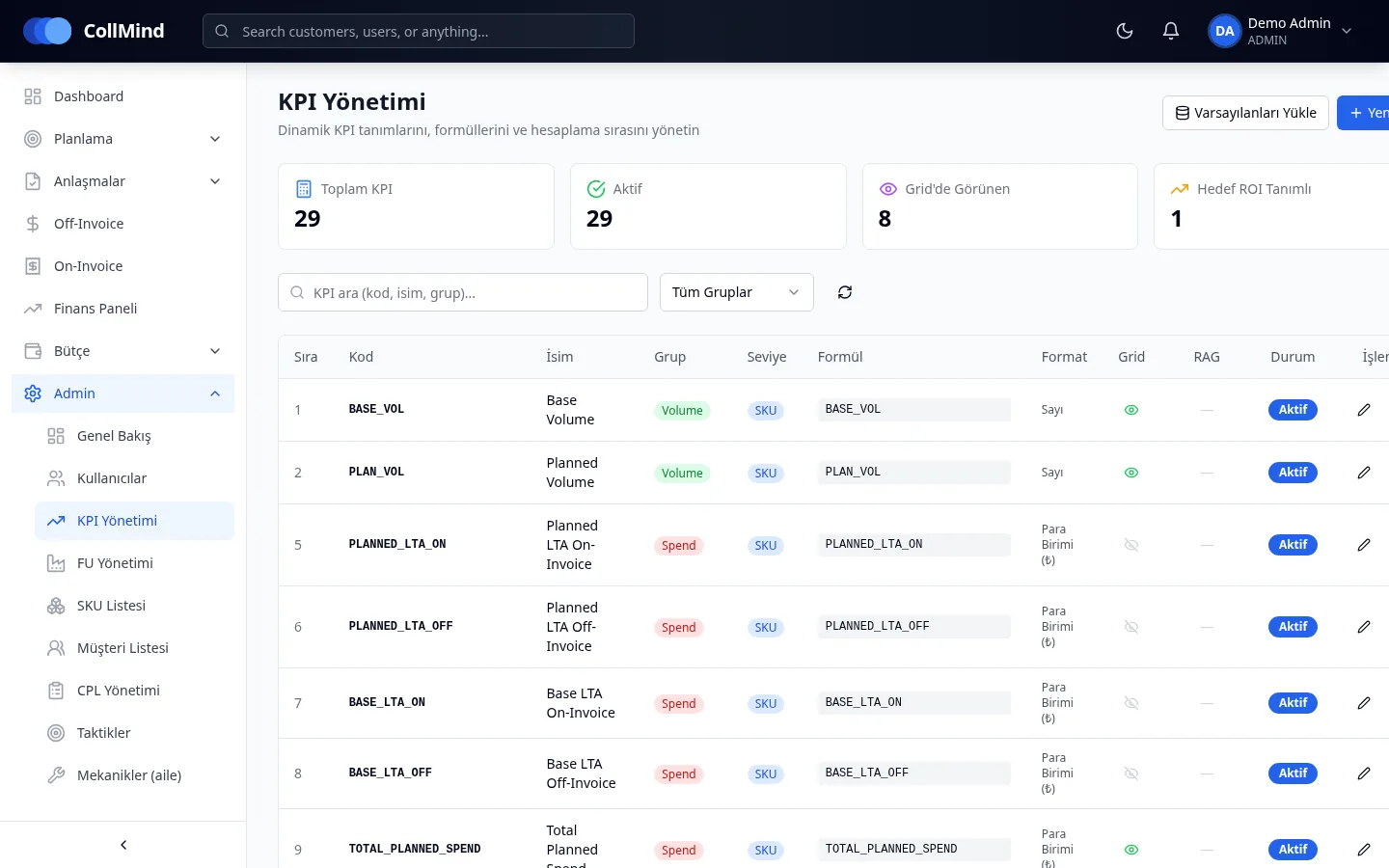
Analytics and KPIs
Formula-based KPIs, plan analysis and a finance dashboard; missing data is never counted as zero.
Explore →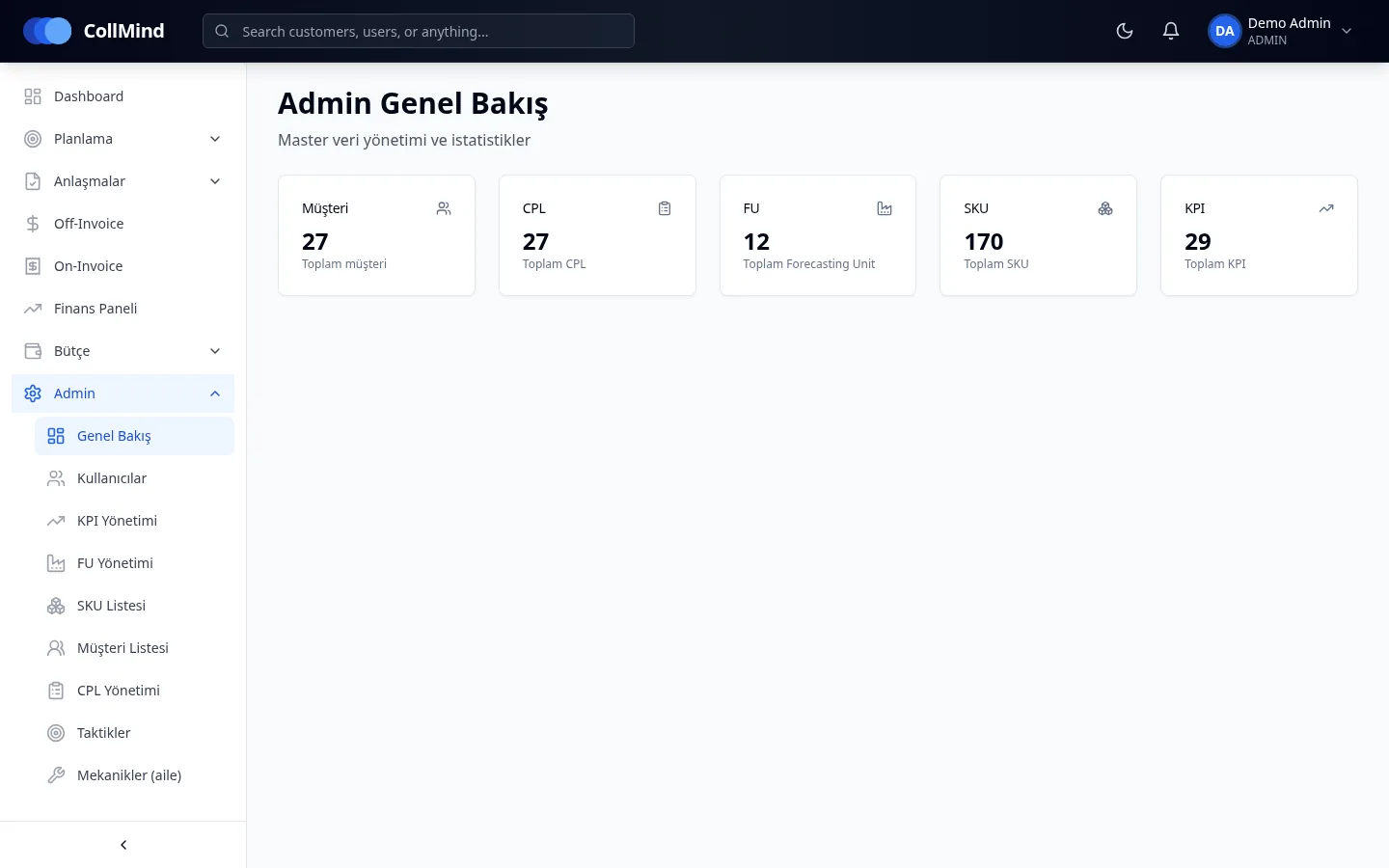
Data, integration and security
Excel/CSV import, REST API, multi-tenant RLS isolation, roles and scopes, an immutable audit trail.
Explore →Screenshots use demo data (Turkish UI).
Four things that set CollMind TPM apart
Numbers you can trust
KPIs are editable formulas, not hard-coded. Missing data is never counted as zero but shown as “could not be calculated”; a product without cost never looks profitable.
The budget really goes down
An approved plan is committed from its envelope, every movement goes to an immutable ledger, and plans are blocked at 100%.
Fast entry at product-group level
Volume spreads to SKUs by historical share and edited cells are locked; no need to enter every SKU by hand.
Built for Turkish trade practice
TRY, imports that reject ambiguous Turkish number and date formats, on/off-invoice split and period-sliced long-term agreement shares.
Roadmap
In development: a claim-centred closed loop where actual sales are matched to agreements (plan → agreement → actuals → matching → claim), and post-promotion evaluation. Planned: the Coll AI assistant, ERP and SFA integrations.
Frequently asked questions
What is trade promotion management (TPM)?
Trade promotion management is how FMCG manufacturers plan, budget, approve, execute, settle and analyse the trade promotions (discounts, inserts, displays, volume rebates) they run with retailers and distributors. TPM software brings the whole process into a single data model.
Is this the same TPM as Total Productive Maintenance?
No. Total Productive Maintenance in manufacturing is also abbreviated TPM. On this page TPM means Trade Promotion Management.
How do you measure a promotion’s real impact?
First, the base volume (what would have sold without the promotion) is set. The difference between planned and base volume is incremental volume; the gross profit it creates is compared with promotion spend to calculate the return (GP ROI).
Is moving from Excel to TPM software hard?
The critical part is not the software but agreeing on definitions. We start from your product and customer structure and existing files, and keep the structures your teams already know.
Let’s calculate your last campaign’s return together
We will use one of your campaigns to show how planning, budget and return calculation work in CollMind TPM.